Learning Case Study
New Manager Certification Program
At a Glance
Audience: Newly promoted and existing people managers across a multinational division
Structure: Internal certification pathway with a six-month completion target
Delivery: Self-paced learning, live facilitated sessions, multi-day workshops, practice sessions, and external instruction
Participation: Primarily voluntary; annual employment-law training was intended to be required
Collaboration: Small internal L&D team working with internal facilitators and external subject-matter providers
My contribution: Facilitation, LMS tracking, reporting automation, program governance, learning analytics, communications, completion recognition, and full design and production of the Hex Awards
The Real Problem
For years, technical or operational success had been treated as sufficient preparation for management. The organization strongly favored internal promotion, preserving institutional knowledge but also passing inherited management practices from one generation of leaders to the next without a shared development standard.
When leadership courses began to become available, participation remained limited. Managers saw disconnected optional classes competing with their “real work,” while senior leaders provided little visible reinforcement that learning to manage people was itself important work. The problem was not simply a lack of training content. Managers lacked a coherent pathway, clear expectations, visible progress, and organizational recognition for developing the skills their new roles required.
The Design Question
How can a small L&D team create voluntary demand for manager development when attendance cannot be mandated and the surrounding culture does not yet treat management as a learned profession?
The Response
Working with a small L&D team, I helped evolve existing and newly developed courses into an internal manager-certification pathway. Focus groups and individual conversations with managers at different career stages helped identify skill gaps, evaluate the existing curriculum, and determine where new or externally developed learning was needed.
The program gave managers a clear target: complete a blended sequence of core learning within six months of promotion. New managers received an introductory package outlining the pathway, upcoming sessions, and expected timeline. Monthly progress reports, completion communications, certificates, and physical achievement tokens made participation visible and reinforced that developing as a manager was meaningful organizational work.
I personally owned much of the program’s facilitation, LMS tracking, reporting and automation, completion communications, outcome analysis, monthly curriculum reviews, and recognition system.
Key Design Decisions
Create a Pathway, Not Another Catalog
A list of optional courses placed the burden on inexperienced managers to determine what they needed and when they needed it. The certification organized separate offerings into a coherent progression with a visible endpoint, expected timeframe, and recognizable accomplishment.
Match the Learning Format to the Capability
Different subjects required different learning structures. Tool and process orientation could be delivered through self-paced learning. Coaching, conflict, communication, and people-management skills required facilitated discussion, practice, reflection, and feedback. The program used the modality that best supported the capability rather than forcing every topic into the same delivery format.
Make Progress Visible and Worth Recognizing
Monthly reports created accountability and social proof without converting the program into another mandatory checkbox. Completion emails, printed certificates, leadership visibility, and Hex Awards reinforced the effort involved and gave managers something tangible to associate with their development.
Every learning challenge must be designed around both the need itself and the larger system in which that need exists.
How It Worked
1. Diagnose the Skill Gaps
The team reviewed existing learning, conducted focus groups, and interviewed managers at different career stages. The goal was not simply to ask which classes people wanted, but to identify the knowledge and behavior gaps affecting real management work.
2. Build a Blended Curriculum
The pathway combined:
Leadership and Management Orientation: Self-paced introduction to major tools, systems, and communication channels
New Manager Fundamentals: Live discussion-based introduction to managing people
Crucial Conversations: Five-day facilitated communication program led by certified internal trainers
Emotional Intelligence: Live course connecting emotional intelligence to management behavior
Employment Law: Externally facilitated annual compliance program
Coaching for Growth: Two-day facilitated program built around the GROW coaching model
Practice and Refresher Sessions: Optional opportunities to revisit and apply communication and coaching skills
Building New-to-Position Training: Self-paced program helping managers design onboarding for their own teams
3. Identify and Invite New Managers
LMS reporting identified employees with direct reports. When a new manager appeared, the L&D team sent an invitation package explaining the certification, required learning, expected completion period, and upcoming course dates.
4. Track and Surface Progress
A monthly report listed active managers, reporting relationships, department, role, location, and completion dates for each program component. Missing annual employment-law training was visibly flagged. Reports were distributed to managers and executives throughout the division.
I eventually developed an Excel-based process that combined LMS exports and automated much of the report population and updating with a single action. It was not ornamental. It worked, which remains a surprisingly controversial standard for internal reporting.
5. Recognize Completion and Evaluate Results
Managers who completed the pathway received a printed certificate, visible completion status in future reports, a congratulatory email sent to senior leadership, and a physical Hex Award. Participation and completion data were later compared with employee engagement and manager-support results from annual HR surveys.
Evidence and Evolution
After monthly reporting began, new managers became more likely to begin the pathway. Most completed at least one-third of the included learning, and approximately 30% of new managers fully completed the certification after the reporting system was established.
Individual courses generally received Net Promoter Scores above 80. Internal comparisons also found:
Employee engagement scores approximately 10–20% higher for employees whose managers completed the pathway
Manager-support scores averaging approximately 25% higher for completers than for managers who did not complete it
Growing interest from leaders in other divisions who requested access to individual programs
These internal comparisons show a meaningful correlation, not proof that the certification alone caused the difference. Manager motivation, leadership quality, and willingness to complete development were likely connected factors. The data nevertheless gave the L&D team useful evidence that participation aligned with stronger employee experiences.
The program also revealed an important limitation. Employment-law completion remained lower than expected when senior leaders did not follow up on the stated requirement. Recognition, reporting, and voluntary motivation could support development, but they could not replace leadership accountability for compliance.
A future version would include:
A more scalable virtual replacement for desk-based awards
Broader public recognition beyond executive emails
Stronger scheduling infrastructure across locations and time zones
Clearer leadership ownership for required learning
More consistent communication of the relationship between manager development and organizational performance
Inside the Work
Manager Development Pathway
A visual curriculum map can show how self-paced orientation, facilitated leadership development, external expertise, coaching practice, and onboarding design worked together as one learning system rather than unrelated courses.
LMS-to-Excel Reporting Workflow
The reporting system transformed LMS data into monthly manager-development reports covering progress, reporting relationships, organizational details, completion status, and compliance gaps. After refinement, much of the process could be updated from an LMS export with a single action.
Completion Communications
Each completion triggered a dedicated message to senior leadership recognizing the manager’s effort. What initially seemed like a modest administrative gesture became unexpectedly meaningful to several participants and reinforced the social value of completing the program.
Hex Awards
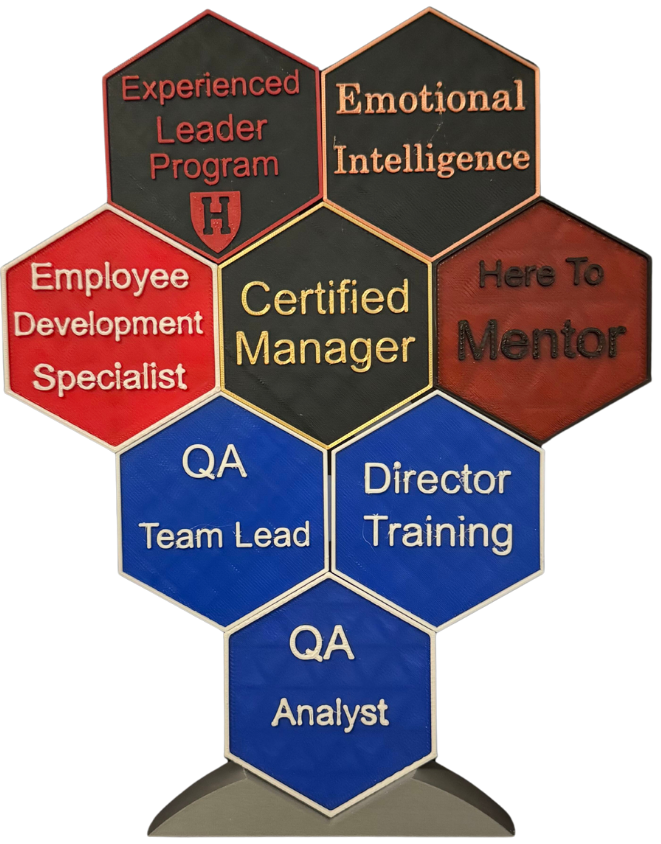
I designed, modeled, printed, and managed a system of modular hexagonal tokens that could connect into desk or wall displays. Different colors and labels represented completed programs, career achievements, leadership roles, and willingness to mentor others.
The awards served several purposes:
Made development visible
Encouraged collection and continued participation
Sparked conversations about learning and career paths
Created a lasting reminder of the accomplishment
Signaled that the organization valued the time invested
Unlike a generic downloadable certificate, the award required enough visible organizational effort to feel intentional.
Capabilities Demonstrated
Manager-development strategy · Training needs analysis · Blended learning architecture · Program adoption · LMS administration and reporting · Reporting automation · Learning analytics · Live facilitation · Curriculum governance · Stakeholder communication · Recognition and motivation design
A voluntary, blended leadership-development pathway that turned a collection of manager courses into a visible, trackable program. Curriculum design, LMS reporting, recognition, and clear completion milestones helped position learning to manage people as part of the job rather than time away from “real work.”